



Galaxy Heating & Air Conditioning installs American Standard, Mitsubishi Electric, Carrier, Rheem, Daikin, Midea, Lennox and Bosch. These eight HVAC brands have different histories and different strengths. The best choice for your Bay Area home comes from understanding both the equipment and the installation it needs.
Some of these businesses began with furnaces. Others started with electrical engineering, metalworking or a problem in a printing plant. One has roots right here in Emeryville. Their stories help explain what they are known for—but the useful question today is what they can do for your comfort.
This guide covers who founded each brand, when its story began, why homeowners consider it, and standout heating and air conditioning systems worth comparing. It is Galaxy's installation-focused perspective, not a laboratory reliability ranking or a claim that every listed model is currently in stock.
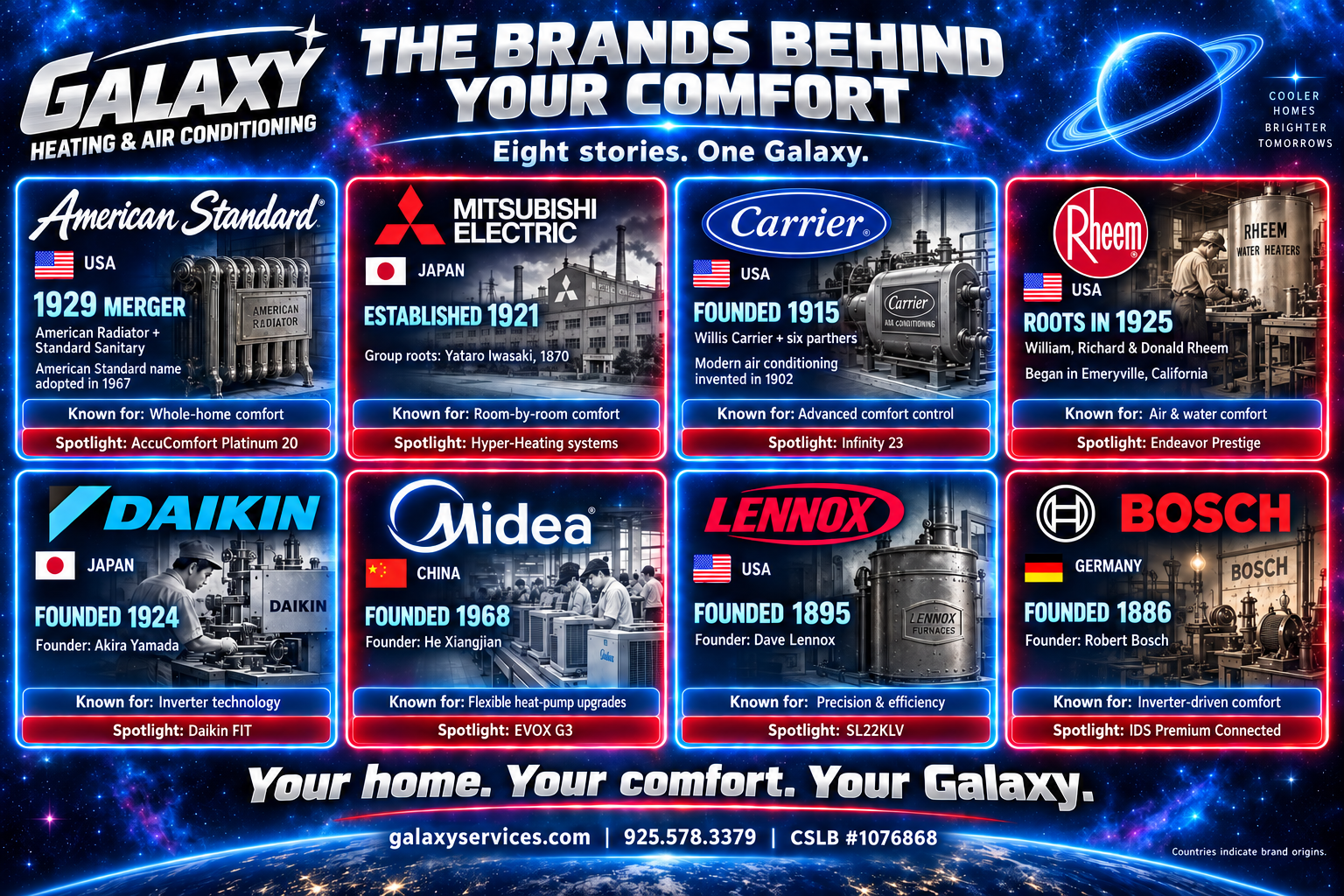
Compare the eight HVAC brands at a glance
“Best systems” means standout options for a particular need—not that the highest-priced model is automatically the right one.
| Brand | Founder or origin milestone | Known for today | Standout systems to compare |
|---|---|---|---|
| American Standard | 1929 corporate merger; American Standard name adopted in 1967 | Whole-home heating and cooling, inverter comfort | 17 SEER-class inverter heat pump; Platinum 18; Platinum 20 |
| Mitsubishi Electric | Established in Japan in 1921; wider group roots with Yataro Iwasaki in 1870 | Ductless mini-splits, zoning and indoor-unit flexibility | Standard single-zone heat pumps; MXZ multi-zone; SUZ/SVZ ducted systems |
| Carrier | Willis Carrier and six partners, 1915; modern AC invention in 1902 | Air-conditioning heritage and a broad residential range | Infinity 23 / 27VNA3; 37MUHA Crossover |
| Rheem | Rheem brothers; Emeryville roots in 1925 | Heating, cooling and water heating; Endeavor equipment | Endeavor Prestige RP19AY; RD18AY side-discharge |
| Daikin | Akira Yamada, Osaka, 1924 | Inverter technology and compact heat pumps | FIT DH7VS; FIT AURORA DH9VS |
| Midea | He Xiangjian and fellow founders, Shunde, 1968 | Inverter heat pumps and value-focused replacement options | EVOX Gen 2; EVOX Gen 3 |
| Lennox | Dave Lennox, Marshalltown, Iowa, 1895 | Furnace heritage, premium efficiency and comfort controls | Signature Collection SL22KLV; Elite EL21KLV |
| Bosch | Robert Bosch, Stuttgart, 1886 | Engineering heritage and inverter ducted systems | IDS Premium Connected; IDS Ultra |
These dates describe company roots or labeled corporate milestones, not the introduction of today's heat pumps or the manufacturing location of every current unit.
Jump to a brand
American Standard · Mitsubishi Electric · Carrier · Rheem · Daikin · Midea · Lennox · Bosch
Also in this guide: Bay Area recommendations · Comparing installation quotes · Frequently asked questions
1. American Standard: a long heating heritage, with comfort that keeps adjusting
Who founded American Standard, and when?
American Standard does not have a simple one-person founding story. Its corporate heritage includes the 1929 merger of American Radiator Company and Standard Sanitary Manufacturing Company, followed by adoption of the American Standard name in 1967. The predecessor businesses were older.
That history connects the name to an era when radiators and modern building systems were changing everyday homes. The shared historical name should not be used to confuse today's heating and air conditioning business with the separate plumbing-products business.
Why homeowners like American Standard
American Standard is worth considering when the goal is a complete ducted system with steady temperatures and a familiar heating-and-cooling identity. Its variable-speed equipment can adjust output as conditions change, rather than treating every call for heating or cooling as identical.
Standout options:
- 17 SEER-class inverter heat pump: an option for homeowners seeking adjustable output and steady central heating and cooling.
- AccuComfort Platinum 18: a variable-speed heat pump for homeowners comparing upgraded whole-home comfort.
- AccuComfort Platinum 20: a premium variable-speed heat-pump option for whole-home comfort.
For a Bay Area homeowner, the benefit is a choice between different levels of inverter-driven whole-home comfort within one brand. Galaxy's comparison focuses on the 17 inverter, Platinum 18 and Platinum 20 options. These names are a starting point, not a guarantee of an exact efficiency rating for every size. We check the rated indoor/outdoor match, controls and duct airflow; a premium outdoor unit is only one part of the system.
Galaxy fit: a strong candidate for homeowners comparing complete central heating and cooling replacements. Explore American Standard systems and the manufacturer's Platinum 18 and Platinum 20 heat pumps.
2. Mitsubishi Electric: different rooms, different comfort needs
Who founded Mitsubishi Electric?
Mitsubishi Electric was established in 1921 as an electrical-machinery business within the wider Mitsubishi industrial history. Yataro Iwasaki began the broader Mitsubishi group's shipping enterprise in 1870; he should not be described as personally founding Mitsubishi Electric in 1921.
The company's early products included electric fans and electrical machinery. Today, its residential HVAC identity is closely associated with heat pumps, ductless mini-splits and flexible indoor-unit designs.
Why homeowners like Mitsubishi Electric
Room-by-room planning is the attraction. A bedroom, an addition and a living room may have different schedules and different heating or cooling needs. Mitsubishi Electric offers wall-mounted units, ceiling cassettes and ducted indoor options, allowing the design to respond to the home instead of forcing the same arrangement everywhere.
Standout options:
- Standard single-zone heat pumps: a practical choice for an individual room or addition, with the appropriate indoor-unit match.
- Standard MXZ multi-zone systems: options for serving several indoor zones from one outdoor system, subject to the approved capacity and combination limits.
- SUZ outdoor unit with an SVZ ducted air handler: a one-to-one central ducted option for homes that need whole-home air distribution rather than wall-mounted indoor units.
Most Bay Area homes do not need Hyper-Heating. Our recommendation starts with standard Mitsubishi heat pumps sized for the home's actual heating and cooling loads. Hyper-Heating is designed for more demanding cold-weather conditions; it is generally unnecessary for this region and is not the feature we lead with when comparing Mitsubishi systems locally. The benefits to focus on here are zoning, indoor-unit flexibility and correctly designed comfort.
Galaxy fit: additions, homes without suitable existing ducts, and projects where individual room comfort matters. Explore Mitsubishi Electric or our mini-split installation service. See Mitsubishi's current heat-pump range for model-specific combinations.
3. Carrier: a printing problem that changed indoor comfort
Who founded Carrier, and when?
Willis Haviland Carrier developed modern air conditioning in 1902 to address humidity problems in a printing operation. In 1915, Carrier and six partners founded Carrier Engineering Corporation.
Those two dates tell different parts of the story: first the invention, then the company. Controlling moisture and temperature helped printing and manufacturing before air conditioning became an everyday feature of homes.
Why homeowners like Carrier
Carrier offers a broad range of residential equipment. A homeowner can compare a straightforward replacement with a premium variable-speed system or a compact crossover arrangement, rather than assuming every Carrier proposal is the same.
Standout options:
- Infinity 23 with Greenspeed Intelligence, 27VNA3: a premium variable-speed heat pump focused on advanced comfort control.
- 37MUHA Crossover: a compact heat-pump option for compatible residential system combinations.
The practical benefit is choice. The right proposal depends on the controls, indoor equipment and installation space, not only the reputation of the name.
Galaxy fit: homeowners who want to compare premium central comfort with compact replacement alternatives. Explore Carrier systems, with manufacturer details for the Infinity 23 and 37MUHA Crossover.
4. Rheem: a home-comfort brand with East Bay roots
Who founded Rheem?
Rheem traces its roots to Emeryville, California, in 1925. Its centennial history credits brothers William, Richard and Donald Rheem, describing an early focus on galvanizing steel drums and other metal products.
That makes Rheem's origin particularly interesting for Bay Area homeowners: this international heating, cooling and water-heating name has a local beginning. Its early metalworking business eventually expanded into the equipment associated with home comfort today.
Why homeowners like Rheem
Many people already recognize Rheem from water heaters. Its HVAC lineup gives homeowners another reason to consider the brand, including inverter heat-pump options and connected controls on supported systems.
Standout options:
- Endeavor Prestige RP19AY: an inverter-driven heat pump with EcoNet capability.
- Endeavor Prestige RD18AY: a side-discharge heat-pump option for projects where that outdoor form factor is useful.
We would compare the actual noise specifications, indoor match, controls and placement. Brand familiarity and local history are appealing, but the home still needs a properly designed system.
Galaxy fit: homeowners seeking an established whole-home comfort brand, with an East Bay story worth knowing. Explore Rheem systems. Rheem's RD18AY product documentation explains its side-discharge platform.
5. Daikin: a century of engineering the air around us
Who founded Daikin?
Akira Yamada founded Osaka Kinzoku Kogyosho in Osaka, Japan, in 1924. That business became Daikin. Its early work included aircraft radiator tubes; later developments extended into refrigeration, air conditioning and climate-control technology.
The story helps explain why Daikin is more than a familiar name on an outdoor cabinet. Air conditioning and related engineering are central to its business history.
Why homeowners like Daikin
The Daikin FIT family combines inverter operation with a compact outdoor format. For a ducted home, that can be attractive when the owner wants an equipment upgrade without giving up as much usable outdoor space to a conventional cabinet.
Standout options:
- FIT DH7VS: a communicating, variable-speed inverter heat pump for a matched whole-home system.
- FIT AURORA DH9VS: a communicating inverter option with enhanced cold-weather capability.
Compact equipment still needs the manufacturer's airflow and service clearances. The right comparison also includes the indoor unit and controls required for the selected system.
Galaxy fit: ducted replacement projects where outdoor placement and adjustable output matter. Explore Daikin systems, with official details for FIT DH7VS and FIT AURORA.
6. Midea: a name worth knowing for inverter comfort and value
Who founded Midea, and when?
Midea began in Shunde, China, in 1968, in a small workshop founded by He Xiangjian and fellow local founders. It grew into a global appliance and technology business.
If Midea is a new name to you, that does not mean it is a new manufacturer. Its company history is much longer than many homeowners' familiarity with its central HVAC products.
Why homeowners like Midea
Galaxy considers Midea a very good option for many Bay Area homes. The appeal is a combination of inverter-driven heating and cooling, flexible central-system replacement options and value when comparing complete installed proposals.
Standout options:
- EVOX Gen 2: a central heat-pump platform worth comparing for a ducted replacement.
- EVOX Gen 3: a newer platform with compatible modular air-handler options for flexible installation planning.
There is a local advantage, too: Bay Area Midea representatives have a substantial selection of equipment and installation supplies. That makes Midea a practical locally supported choice. Galaxy checks current availability for the exact system rather than promising every part is always on a shelf.
EVOX offers a 12-year limited parts and compressor warranty for eligible residential original purchasers under Midea's applicable extended warranty terms. Registration provisions and exclusions apply; installer labor coverage is separate.
Galaxy fit: homeowners seeking modern central heat-pump comfort and a strong value proposition. Read our Midea brand review and EVOX Gen 2 versus Gen 3 comparison, or explore Midea systems. Manufacturer resources: EVOX systems and warranty terms.
7. Lennox: from a furnace workshop to precise comfort control
Who founded Lennox?
Dave Lennox's business began in Marshalltown, Iowa, in 1895, with riveted-steel furnaces at the center of its early story. The company developed from a heating-equipment business into a broader residential heating and cooling brand.
That furnace heritage remains part of Lennox's identity, even as modern heat pumps, digital controls and indoor-air-quality options have expanded the range.
Why homeowners like Lennox
Lennox is worth considering when a homeowner prioritizes premium comfort features and wants to compare the complete system: outdoor equipment, indoor unit, controls and supporting airflow.
Standout options:
- Dave Lennox Signature Collection SL22KLV: a premium variable-capacity cold-climate heat pump.
- Elite EL21KLV: another variable-capacity cold-climate option in Lennox's residential range.
Variable-capacity operation can help equipment respond more gradually to changing loads. The relevant efficiency and heating performance are those of the proposed equipment match, not simply the highest number advertised anywhere in the lineup.
Galaxy fit: homeowners comparing premium heating and cooling systems with advanced comfort control. Explore Lennox systems and manufacturer information for SL22KLV and EL21KLV.
8. Bosch: engineering heritage meets inverter ducted comfort
Who founded Bosch, and when?
Robert Bosch opened his Workshop for Precision Mechanics and Electrical Engineering in Stuttgart, Germany, in 1886. That is the origin of the Bosch company—not the launch date of its modern residential heat pumps.
Many homeowners know Bosch from appliances, automotive technology or tools. Its home-comfort equipment is another application of that broader engineering identity.
Why homeowners like Bosch
Bosch's Inverter Ducted Split, or IDS, systems bring inverter-driven compressor control to central heating and cooling. They are worth considering for homeowners who want a ducted heat-pump replacement and equipment that can adjust its output.
Standout options:
- IDS Premium Connected: an inverter ducted system with connected monitoring features.
- IDS Ultra: a cold-climate heat-pump option designed for stronger low-temperature heating capability.
Cold-climate performance is useful when the home needs it; it does not automatically make the most capable winter model the best value in every coastal neighborhood. Controls and indoor-unit compatibility should be checked for the exact proposal.
Galaxy fit: ducted replacement projects where inverter operation and practical system integration matter. Explore Bosch systems, with manufacturer details for IDS Premium Connected and IDS Ultra.
Which HVAC brand is best for your Bay Area home?
The brand comparison gets more useful when you start with the building.
Contra Costa County: summer cooling, airflow and room balance
For homes in Walnut Creek, Concord and Danville, summer heat, sun exposure and upstairs comfort can be important design drivers. We compare cooling capacity, return-air paths and duct condition alongside the equipment features.
A larger outdoor unit is not a substitute for solving poor airflow. A well-selected ducted system or an appropriately designed zoned system can each be a good answer, depending on the house.
Planning a replacement in Danville? Use our Danville homeowner HVAC guide to check permit jurisdiction, record room-comfort problems, and compare complete installation quotes.
Alameda County: consider the home, not just the county
An Oakland home and a Pleasanton home can have very different cooling loads and installation constraints. We look at insulation, windows, existing equipment, outdoor space and the owner's heating preferences before recommending a brand or capacity.
For an older ducted home, compare a complete central replacement. For an addition or rooms without useful ducts, compare mini-split and concealed-duct options.
San Francisco: placement, access and the right operating range
In San Francisco, close neighbors, limited outdoor space and access can be just as important as a headline efficiency rating. Compact equipment is useful only if the location provides approved airflow, service access and appropriate sound planning.
We also consider how the system operates during the region's more moderate conditions, not only its maximum heating or cooling output.
How to compare quotes across different HVAC brands
Ask each contractor to describe the same scope so you are comparing complete systems:
- Home assessment: What heating and cooling loads is the selection based on?
- Equipment match: What are the exact outdoor and indoor model numbers, and the rated matched-system performance?
- Air distribution: Are duct repairs, return-air improvements or additional indoor zones included?
- Controls: Which thermostat or controller supports the promised features?
- Installation scope: What electrical work, piping, drainage, permits and restoration are included?
- Commissioning: How will airflow, system operation and manufacturer-required setup be checked?
- Support: What equipment is available, what does the manufacturer's warranty cover, and what labor coverage does the installer provide?
If replacing a furnace, discuss whether an all-electric heat pump, an appropriate dual-fuel system or another furnace installation fits your goals. A heat pump is not automatically cheaper to operate in every Bay Area home; utility rates, equipment performance and usage affect that comparison.
For a gas-furnace project in Dublin, our Dublin furnace installation guide covers permit documents, attic or closet access, venting and condensate changes, and compatibility with an existing air conditioner.
For Oakland homes, our heat-pump installation guide compares ducted and ductless layouts, outdoor placement, electrical scope and the City's permit paths for different building types. If the immediate problem is a furnace that is not heating, start with the Oakland furnace-repair guide instead.
Galaxy can help compare heat-pump installation, mini-split installation and furnace replacement around the property rather than a brand ranking.
Frequently asked questions
Which HVAC brands does Galaxy install in the Bay Area?
Galaxy installs American Standard, Mitsubishi Electric, Carrier, Rheem, Daikin, Midea, Lennox and Bosch. We compare the equipment, system design, local availability and installation scope for the home rather than choosing by brand name alone.
What is the best HVAC brand for a Bay Area home?
There is no single best brand for every Bay Area home. Mitsubishi Electric is worth considering for room-by-room zoning; American Standard, Carrier and Lennox offer premium whole-home options; Daikin, Midea, Bosch and Rheem provide additional inverter heat-pump choices. The best fit depends on the house and complete equipment match.
Which HVAC brand started in the Bay Area?
Rheem traces its roots to Emeryville, California, in 1925. Its centennial history credits brothers William, Richard and Donald Rheem and describes an early focus on galvanizing steel drums and other metal products.
Who founded Carrier, and when?
Willis Haviland Carrier and six partners founded Carrier Engineering Corporation in 1915. Carrier's development of modern air conditioning in 1902 was an earlier milestone, not the company's founding date.
Was Mitsubishi Electric founded in 1870 or 1921?
Mitsubishi Electric was established in 1921. The wider Mitsubishi group's roots go back to Yataro Iwasaki's shipping business in 1870. These are different organizations and historical milestones.
Is Midea a good HVAC brand with local Bay Area support?
Yes. Galaxy considers Midea a strong Bay Area option, and local Midea representatives have a substantial selection of equipment and installation supplies. EVOX offers a 12-year limited parts and compressor warranty for eligible residential original purchasers under the applicable terms; labor coverage is separate.
Does the HVAC brand matter more than the installation?
Both matter, but a premium brand cannot correct poor sizing, unsuitable ductwork or an incorrect equipment match. Compare the brand's features alongside the load assessment, airflow, controls, installation quality, commissioning and written warranty.
Eight brands. One local installation team.
Every brand here offers a different starting point. The final result comes from choosing equipment that fits the home and installing it correctly.
Galaxy Heating & Air Conditioning helps Bay Area homeowners compare American Standard, Mitsubishi Electric, Carrier, Rheem, Daikin, Midea, Lennox and Bosch. Tell us what you want to improve—summer cooling, uneven rooms, outdoor noise, an aging furnace or a complete heating-and-cooling upgrade—and we can build the comparison around those priorities.
Request an in-home estimate or call 925-578-3379 to discuss your options.
About the Author
Galaxy Heating & Air Conditioning
NATE-Certified HVAC Experts
Galaxy Heating & Air Conditioning has been serving the San Francisco Bay Area since 2008. Our team includes NATE-certified technicians and EPA-certified professionals specializing in residential HVAC systems, energy-efficient installations, and emergency repairs. We stay current with the latest HVAC technologies, California building codes, and manufacturer certifications to provide accurate, trustworthy information to Bay Area homeowners.
Sources & References
This article references authoritative sources to ensure accuracy and reliability:
- American Standard Corporate HeritageAmerican Standard Manufacturer
- Mitsubishi Electric Company HistoryMitsubishi Electric Manufacturer
- Carrier Engineering Corporation: 1915–1922Carrier Manufacturer
- Rheem: 100 Years of HistoryRheem Manufacturer
- Daikin Corporate ChronologyDaikin Manufacturer
- Midea Brand StoryMidea Manufacturer
- Lennox International Annual Report: Company OriginsLennox International Manufacturer
- Bosch Company HistoryBosch Manufacturer
Note: This information is provided for educational purposes and reflects current industry standards and regulations. For specific applications to your home or business, consult with a licensed HVAC professional. Call Galaxy Heating & Air at (925) 578-3379.
Need Professional HVAC Service?
Galaxy Heating & Air provides expert HVAC services throughout the San Francisco Bay Area. From installations to repairs, we're here to help 24/7.